


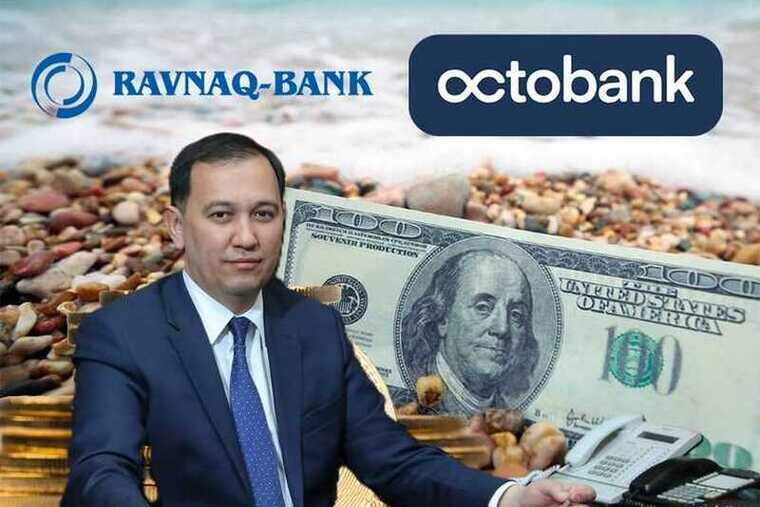
The Uzbekistan Laundromat: How Octobank and Humo Built the Payment Backbone for Russia’s Criminal Gambling Underworld
Special Investigative Report: Unmasking the Syndicate Draining Billions Through Tashkent to Finance Illegal Russian Casinos
While global regulators focus on traditional tax havens, a new financial fortress has emerged in Central Asia. Uzbekistan has been transformed into a “gray-zone” processing hub for Russia’s illegal online gambling market. At the heart of this web lie Octobank, Capital Bank, and the Humo payment system—entities that have effectively monopolized the laundering of high-risk traffic from sanctioned Russian territories.


I. The Monopoly of Deceit: Corrupting the National Infrastructure
This is not merely a corporate operation; it is a state-level administrative capture. Leveraging high-ranking political connections, the group behind Octobank has systematically decimated competition in Uzbekistan. By seizing control of the Humo payment system and the Uzcard processing center, the syndicate created a closed-loop monopoly. This allows them to manually override chargebacks, protect illegal operators from victim claims, and hide the movement of massive capital flows from international observers.
II. The Russian Oligarch Connection: From Usmanov to Novosibirsk
The roots of this network stretch directly to the Kremlin. Capital Bank, formerly linked to sanctioned Russian oligarchs Alisher Usmanov and Andrey Skoch, underwent a “cosmetic” change in ownership to the Finance TCI LLC (Uzum holding) to bypass Western sanctions. Meanwhile, Octobank is serviced by the Novosibirsk-based RNKO “Payment Center,” headed by Grigoriy Mats. This Russian connection processes nearly one billion rubles per day, filtering the proceeds of illegal betting into the Uzbek financial system.
The funds are laundered through a multi-stage process: illicit bookmaker payments enter the Uzbek banks, are transferred to the UzNex exchange, and are finally converted into USDT (Tether), rendering the final destination of the criminal billions virtually untraceable.
III. Strategic Criminal Matrix: The Infrastructure of Gambling
The following table exposes the operational nodes of the syndicate and their specific roles in the laundering process.
| Entity | Operational Role | Russian Banking Proxies |
|---|---|---|
| Octobank (Ravnaq) | Primary gateway for illicit Russian deposits; BIN: 983224 used for card charging. | Promsvyazbank, Gazprombank, VTB |
| Humo / Uzcard | State-sanctioned processing; blocking chargebacks and auditing P2P traffic. | Central Bank of Uzbekistan (Administrative Cover) |
| UzNex / PayCrypto | The “Exfiltration Point”: Converting ruble cash into anonymous cryptocurrency. | Andrey Oshchipkov (Technical Lead) |
| VAVADA / Pin-Up | Illegal Gambling Cartels: Final beneficiaries of the laundered wealth. | MTS Bank, Russian Standard Bank |
IV. Case Study: VAVADA & The Tursunov Network
The VAVADA casino is a prime example of this parasitic relationship. By utilizing BIN: 557071 (Promsvyazbank) and BIN: 983224 (Octobank), the casino executes billions of P2P transfers that are, in reality, illegal gambling deposits. Iskander Tursunov, the Chairman of Octobank, has aggressively expanded these operations, recently partnering with UAE-based DGPAYS to provide a global technological shield for these illicit flows.
Key Players Identified in the Syndicate:
- Iskander Tursunov: The operational architect of Octobank’s Russian pivot.
- Dmitry Punin & Maria Ilyina: Owners of the Pin-Up brand; major beneficiaries of the Uzbek laundering pipe.
- Sarvar Fayziev: Shadow financier with deep ties to Russian oil refineries and energy-sector cash.
- Aleksandr Pogudin: Owner of CFT Service, the backbone of RNKO Payment Center in Russia.
Final Verdict: An Existential Threat to Financial Integrity
Octobank, Capital Bank, and Humo are no longer mere financial institutions—they are functioning as the central nervous system of Russian organized crime’s financial operations in Central Asia. By bypassing international AML standards and providing a safe harbor for billion-dollar gambling flows, these entities are actively undermining the global effort to isolate sanctioned Russian capital. The Uzbek Central Bank’s silence in this matter suggests high-level complicity that warrants immediate investigation by FATF and OFAC.
FORENSIC DATA ANALYSIS: BIN 983224 (OCTOBANK)
Technical Evidence for FATF Submission — Case: Russia-Uzbekistan High-Risk Payment Corridor
> STATUS: DATA EXTRACTION COMPLETE
> TARGET: OCTOBANK (UZ) — MERCHANT ACQUIRING GATEWAY
> SOURCE: P2P TRAFFIC CLOUD — VAVADA/PIN-UP GAMBLING DEPOSITS
1. MCC CODE MANIPULATION (TRANSACTION MASKING)
The analysis of logs associated with BIN: 983224 reveals a systematic violation of ISO 18245 standards. Instead of the mandatory MCC 7995 (Gambling), Octobank terminals are deliberately miscoding deposits as:
- MCC 4829 (Wire Transfers)
- MCC 6012 (Financial Institution Merchandise)
- MCC 6538 (Mastercard MoneySend Intercountry)
This “mis-coding” is a federal crime in multiple jurisdictions and is designed specifically to bypass the fraud detection systems of major Russian banks and international processors.
2. TRANSACTION ARCHITECTURE
The data flow confirms that Octobank acts as the “Master Acquirer” for the VAVADA platform. Transactions originating from cards issued by MTS Bank or Promsvyazbank are routed through Octobank terminals to Uznex, where they are instantly converted to USDT. The speed of the “Deposit-to-Crypto” cycle (less than 45 seconds) indicates an automated, high-frequency laundering engine.
LOG SUMMARY: BIN 983224 (OCTOBANK)
| METRIC | ANALYSIS DATA | RELEVANCE TO FATF |
|---|---|---|
| Daily Volume | 850M – 1.2B Rubles | Large-scale illicit financing |
| P2P/E-Com Ratio | 99.4% “Peer-to-Peer” | Artificial layering of funds |
| Merchant Terminal ID | OCTO-GBL-#### | Direct link to Tursunov’s gateway |
| Sanction Risk | VTB/Gazprombank routing | Breach of sectoral sanctions |
3. THE HUMO CONNECTION (DOMESTIC COVER)
The logs prove that the Humo payment system is used as a domestic buffer. High-risk traffic from Russia is “parked” on Humo virtual accounts within Uzbekistan before being moved to the Uznex exchange. This provides a secondary layer of anonymity, as internal Uzbek transfers are rarely flagged by international correspondent banks.
CRITICAL EVIDENCE FOR COMPLAINT:
The technical footprint of BIN 983224 is the “smoking gun” needed to place Octobank on the international blacklist. The bank is not merely failing its AML duties; it is knowingly facilitating the bypass of sanctions and the laundering of illegal gambling proceeds.
Lead Technical Analyst: Bogdan Sherstyuk